


From Brussels to Britain: building the case for a peace budget
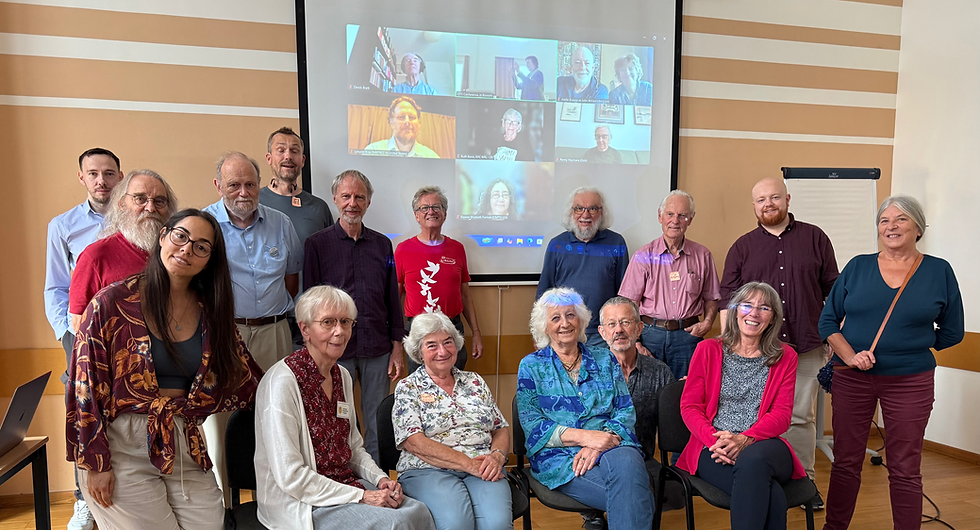
Supporters across the UK helped send our two part time members of staff to the 18th International Conference on Conscientious Objection to Military Taxation. We returned with sharper arguments, practical lessons and renewed international relationships for a simple demand: peace needs investment, institutions and political commitment.

In July, we asked Conscience supporters to help us raise funds towards sending two UK representatives to Brussels. We made a promise: to carry the British campaign into an international conversation and bring back ideas, relationships and experience that could strengthen our work here. Supporters from around the UK
made that possible.
We did not return with an easy victory or a finished blueprint. We returned with something more useful: evidence that peace-tax campaigning can still reach new generations; a clearer account of what a peace budget could actually build; and a stronger understanding of how Conscience’s work in Britain fits into the defence of conscientious objection internationally.
Forty years in one room

We arrived on Friday evening at the conference centre in Brussels. What was described on the programme as a social evening became something more unusual: an evening of remembering. Around the room were people who had not merely studied the peace-tax movement’s history. They had made it.
Klaus Waiditschka, one of the German movement’s pioneers, recalled finding a Canadian Catholic newspaper on a table in Lusaka, Zambia, in the early 1980s. It contained a letter from a bishop in Seattle explaining why he was withholding half his income tax in protest against military spending. Klaus took the paper home, translated the letter into German and helped it circulate. It became one of the sparks of the German peace-tax movement. A few years later, he helped organise the first international conference in Tübingen in 1986.
Monica Frisch, a member of Conscience’s Executive Committee who became involved around 1980, remembered coming to the fourth conference, also in Brussels, in 1992. Conscience was small and the idea still felt novel, but its moral logic struck her immediately: if you oppose war, why should you be compelled to pay for it?
Wolfgang Steuer, another long-standing German campaigner, recalled the organisers, interpreters and campaigners whose largely unseen labour allowed a multilingual movement to survive across borders.
These were not nostalgic anecdotes placed around an anniversary. They were a reminder that movements are built through translation, newsletters, court cases, patient organising and people carrying an argument when it is unfashionable. Forty years later, the political environment has changed dramatically, but the moral question has not disappeared.
Taking the UK report into the room
Jonathan presented Conscience’s report on the past two years. It was deliberately candid. Our long-term aim remains legislation allowing people with a conscientious objection to redirect the military portion of their taxes towards peacebuilding. But in a political climate where higher military spending is increasingly treated as inevitable, we have shifted our immediate emphasis towards building the public understanding and support that future legislation will require.
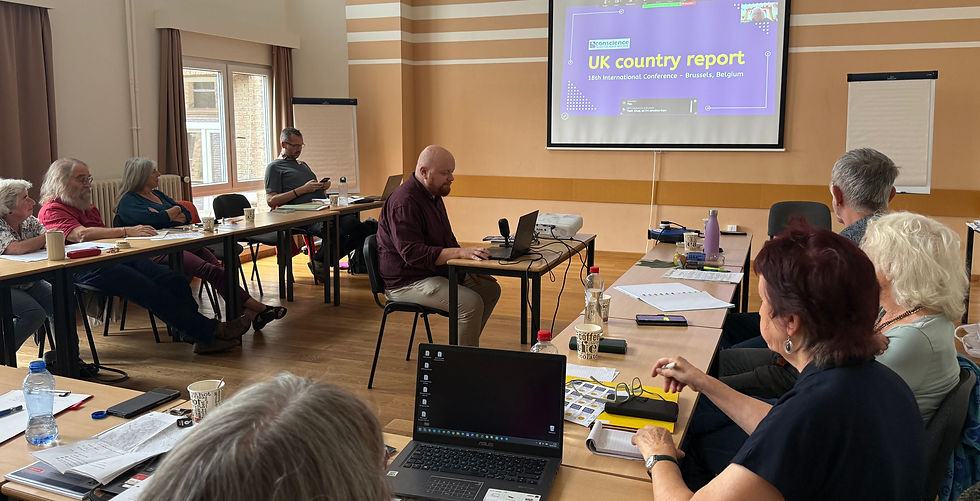
We described Peace Tax Tuesdays, our weekly attempt to connect the campaign with current events; new educational resources on non-military security and converting arms-industry skills to socially useful work; regular website and social-media campaigning; and the creation of the Supporters’ Panel. The Conscientious Objectors’ Day petition we supported attracted more than 1,000 signatures, and we joined 54 other organisations in challenging higher military spending.
We also named the difficulty. Conscience has two part-time staff members. Our supporter base is declining, legislative progress is limited, and growing online attention does not automatically produce sustained participation or income. Presenting those realities internationally allowed us to compare them with campaigns facing the same problem in different forms, and to ask what can genuinely be learned rather than simply exchanged.
Three lessons from the country reports
The country reports did not offer one model for Britain to copy. Tax systems, laws and political cultures differ too much for that. They did, however, reveal three lessons with direct relevance to the UK peace movement.
First, new engagement is possible when people are offered clear information and a practical route into action. The US National War Tax Resistance Coordinating Committee reported extraordinary digital growth. Its annual website audience rose from roughly 40,000 unique visitors before the war in Gaza to almost 400,000 in 2025 and more than one million so far in 2026. Its Instagram following grew from around 600 to more than 42,000, accompanied by regular online ‘War Tax Resistance 101’ sessions. The American legal and tax context cannot simply be transferred to Britain, where PAYE removes much individual control. But the communications lesson travels: people respond when a moral concern is connected to something understandable that they can do next.
Second, a peace-tax proposal becomes stronger when it is concrete. The revived Belgian campaign proposes that citizens redirect 11 per cent of their personal income tax, the portion it calculates is connected to military and related spending, into a provisional peace fund. Its ambition is to involve 1,000 people and generate public debate while building support for an official fund. The proposal is still developing and coalition support is not guaranteed, but it gives people something tangible to discuss: not whether they should pay tax, but what their tax should be allowed to build.
Third, good arguments do not organise themselves. Germany’s campaign continues to pursue legal cases, petitions and alliances within a climate increasingly dominated by military responses to insecurity. Jan Birk, chair of the German peace-tax network, captured a problem familiar to many small British peace organisations.
“There is a frightening difference between the force of our arguments and the force of our numbers.” Jan Birk, Netzwerk Friedenssteuer |
That observation is not a counsel of despair. It is a strategic instruction. Moral clarity has to be joined to public education, accessible actions, alliances and the patient conversion of sympathy into organised support.
Peace is work, and work needs a budget
The conference theme, ‘Give Peace a Budget’, was not accepted as a finished slogan. Participants challenged it. Peace can sound vague or passive; different people mean different things by it; and governments routinely describe military preparation as ‘defence’ or even as the preservation of peace. One Belgian participant reminded us that peace is harder than war because it demands more than the decision to use force.
The value of the discussion was therefore in making the alternative specific. A peace budget could support diplomacy and mediation; early conflict prevention; peace education; unarmed civilian protection and social defence; development and climate responses that address the causes of conflict; and a just transition that allows workers’ skills to move from arms production into socially useful industries. One distinctly British proposal was a structured problem-solving unit connected to the Foreign Office, able to combine country knowledge with mediation and conflict-resolution expertise before violence becomes the default response.

The ideas placed on the conference wall were concise: ‘Budgets are political choices.’ ‘Unarmed security needs a budget.’ ‘A conflict is a problem to be solved, not a war to be fought.’ Together, they shifted the argument from a request for less harm to a demand for the infrastructure that makes peace possible.
Monica put the question more directly: ‘Can’t we cut out the killing stage and go straight to diplomacy?’ Robin Brookes, CPTI’s chair and a long-standing war-tax resister, connected that positive alternative back to conscience. Money is not morally inert simply because an individual taxpayer cannot trace a particular pound to a particular weapon.
“Money actually does things … We have a responsibility. We have agency. It matters where we get our money from, and it matters where we put our money.” Robin Brookes, Chair of Conscience and Peace Tax International |
Protecting conscience internationally
Sunday’s discussion examined CPTI’s work at the United Nations, where it has held consultative status since 1999. Much of the immediate work is necessarily defensive: documenting violations of the right to conscientious objection to military service, protecting people facing conscription or punishment, and ensuring that this right remains visible within the Human Rights Council.
The discussion also exposed a genuine strategic tension. Working on the better-established right to refuse military service creates legal credibility and protects people in immediate danger. Yet the movement must not allow its founding concern, the right to refuse financial participation in war, to disappear because it is politically harder. As Monica explained from the UK perspective, Britain’s history of conscription includes legal recognition of conscientious objection to military service; there is still no corresponding right to redirect the part of our taxes used to fund war.
Participants considered a draft three-year strategy covering UN advocacy, relationships with other peace and human-rights organisations, clearer communications and better sharing of resources. Rather than adopting the entire programme on the spot, participants acknowledged the network’s limited capacity and agreed an online follow-up so that the network can examine realistic first-year steps, including more regular communication, a clearer map of member organisations, shared campaign resources and stronger working relationships with international partners.
‘Nice people met and talked. So what?’
Near the end of the weekend, one German participant asked how people outside the room might respond to our photographs: nice people came together, talked, and so what? It was the right question. Every supporter who helped fund our participation is entitled to ask it.
A conference cannot pass a Peace Tax Bill or reverse Britain’s military spending by itself. What it can do is stop small campaigns repeatedly inventing the same work in isolation. It can carry successful ideas across borders, subject weak ideas to friendly challenge, maintain relationships that protect conscientious objectors, and turn private moral discomfort into a shared political demand.

Conscience did not attend as an observer. Jonathan, presented the UK country report, helped facilitate the hybrid discussions and led part of the workshop on giving peace a budget. Fay, prepared the visual timeline marking forty years of conferences that will be
used throughout reports and communications materials, contributed to the communications and strategy discussions, documented the gathering and took the formal General Assembly minutes. Together, we shared Conscience’s materials, answered questions about the British campaign and brought its experience into decisions about CPTI’s future work.
We have returned with practical tests for our own campaigning: explain what peace investment would fund, not only what we oppose; create lower-barrier routes from concern to participation; make better use of international evidence and resources; reach younger audiences without abandoning long-standing supporters; and place conscientious objection to military taxation inside the wider British debate about what genuinely makes people secure. These lessons can now feed into Peace Tax Tuesdays, our Education for Peace resources, the Supporters’ Panel and our international work.
Friday evening showed us a movement carried across forty years by people willing to translate an unfamiliar idea, put their name to an unpopular argument or keep an organisation alive through difficult political periods. Sunday left us with the responsibility not merely to honour that history but to make it useful.
War already has budgets, departments, recruitment systems, research programmes and industrial strategies. Peace cannot be left to goodwill after the spending decisions have been made. It needs institutions, skills, public investment and democratic support, and people must have the right to ensure that their taxes help build it.
To everyone who helped send us to Brussels: thank you. Your support placed the UK campaign in that international room and has brought its arguments, experience and possibilities back home.


Comments